Kev gets a space coach...
Meet Kirby Runyon, who trains civilian astronauts on their years long journeys to go to space.

Hello, future. It’s me, Kev — I got a space coach.
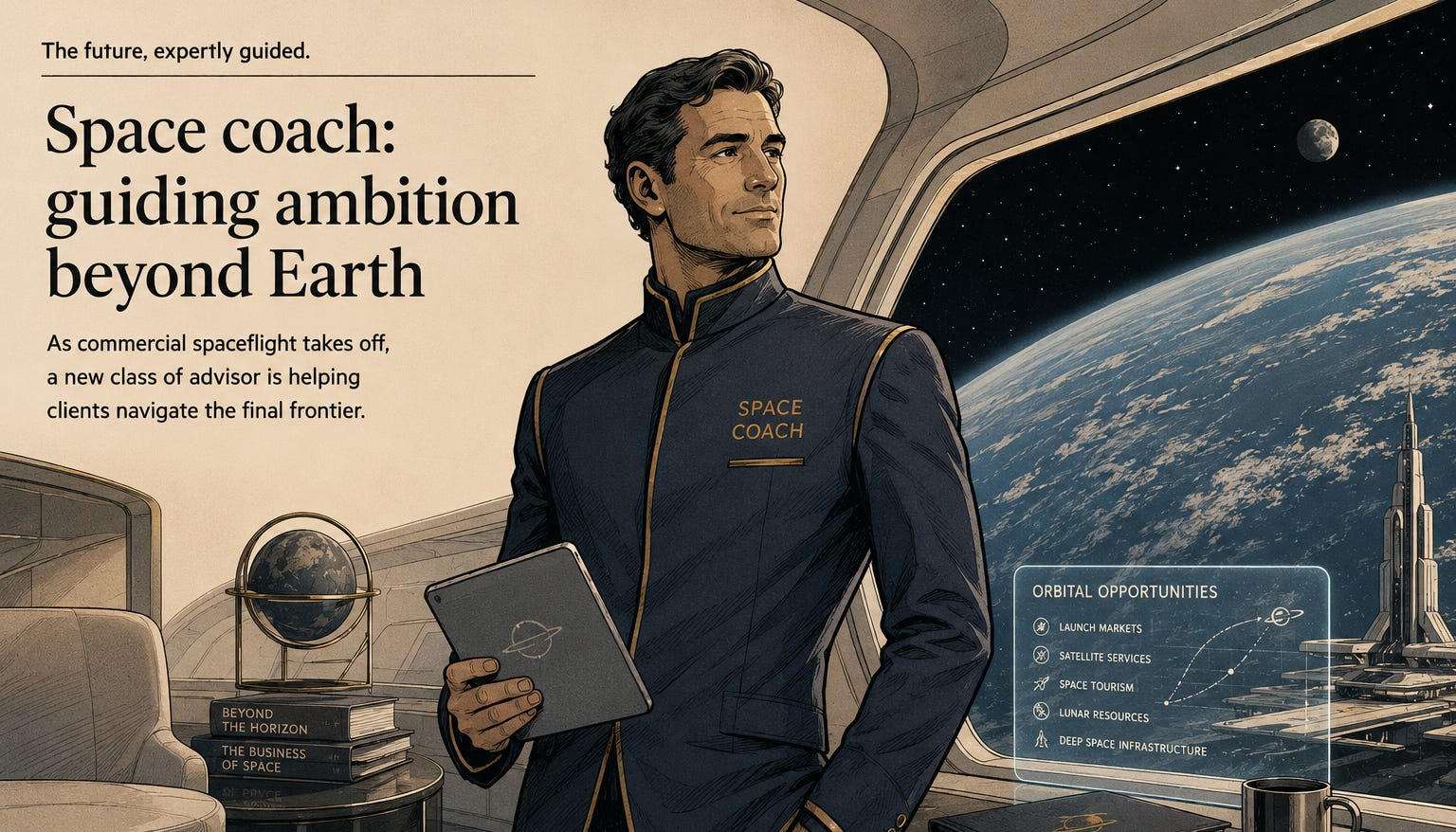
His name is Kirby Runyon. He works with NASA, the Planetary Society, and the Planetary Science Institute. Kirby trains civilian astronauts. He’s also a planetary geologist, a published scientist in some the biggest science journals in the world, and has single handedly convinced me that the Moon is a planet.
So, yeah, not a bad guy to help coach me on my mission. Listen to my conversation with him on my iHeart Media show HELLO FUTURE with Kevin Cirilli. Subscribe to HELLO FUTURE: iHeart | iTunes | Spotify | Amazon | Pandora
And for those new here, allow me to out myself: Since I was a little kid growing up in Delco: I’ve wanted to go to space since I was a kid, and now I realize I didn’t have to figure it out alone.
What Does a Space Coach Actually Do?
Kirby is helping me understand what it really takes to prepare for space — both physically and mentally. He’s teaching me about training, fitness, and the mental toughness required for long missions. He even keeps mentioning something called the Vomit Comet (I’ll explain that one later). More than anything, he’s helping me understand that space is a team sport. Nobody gets there alone.
Lifelong dream
Growing up outside Philadelphia, my friends and I invented a game called Party on Mars. Every day at recess, we’d turn the blacktop into the Red Planet. We didn’t know anything about rockets or gravity. We just knew there was something bigger out there than the streets we grew up on.
Even back then, I was drawn to stories that made the impossible feel possible. Ursula K. Le Guin’s quiet universes. Madeleine L’Engle’s A Wrinkle in Time. Interstellar. The Martian. Apollo 13. Star Wars. October Sky. The Book of Strange New Things. These stories didn’t just entertain me — they gave me permission to dream bigger than my neighborhood.
At Bloomberg TV and Bloomberg Radio where I had a stint as the chief Washington correspondent, I once interviewed an astronaut and said out loud on air that I wanted to go to space someday.
A client later told me I should probably stop saying that because it sounded weird. She said it at the place Neil Armstrong studied to be an astronaut. I didn’t fight her. I just quietly decided that wasn’t the kind of person I wanted to keep working with. And I didn’t shut up. I launched meet the future (mtf.tv, but soon to be expanded into mtf.news).
For me, space has always been about the art of what’s possible — not just for me, but for all of us. And the truth is, almost nothing big in space happens alone.
I’ve spent more than a decade covering Washington policy. I’ve sat in rooms with powerful people. Some of it was interesting. (A lot of it was not.) But candidly, most of it played out like a re-run. Nothing has ever lit me up the way space does. There’s something about the idea of leaving Earth that feels like the ultimate act of hope. That’s why I finally made a decision.
Everybody Needs a Space Coach
I reached out to Kirby because I knew I couldn’t do this by myself. He’s helping me understand what it really takes — and more than anything, he’s helping me understand that space is a team sport.
Every major mission in space is built by thousands of people. Take Artemis II, the first crewed flight around the Moon since Apollo 17. On April 1, 2026, four astronauts traveled farther from Earth than any humans ever have. But behind them were more than 2,700 companies and thousands of workers across America and Europe. Lockheed Martin. Boeing. Northrop Grumman. Airbus. Hundreds of smaller companies. International partners from Canada, Europe, and Japan. California alone contributed more than 500 companies and 16,000 workers.
That’s what it takes to reach for the stars.
Space exploration is at its best when it includes all kinds of people — not just professional astronauts, not just celebrities, not just billionaires.
Space Will Be a Pharmacy
And more than anything — literally, with all my heart — I want to go to space to help with medical research.
Here’s the simple reason why: When people live in space, their bodies change in ways we still don’t fully understand. By taking blood samples up there, scientists can see exactly what’s happening inside the human body. This helps them create better medicine — not just for astronauts, but for people right here on Earth too.
It’s like trying to fix a car but only being able to look at it from far away. Going to space lets scientists look under the hood while it’s running.
The truth is, space is going to become a pharmacy. In the future, some of our most important medicines may be made, improved, or even discovered in orbit. If we invest in this research now, we could unlock treatments that are impossible to create on Earth.
Don’t believe me? Here’s what that research looks like right now, grouped by what they’re trying to help:
—> HIV and AIDS: Varda Space Industries has already grown better crystals of an HIV medication in orbit, creating a more stable and effective version of the drug.
—> Cancer: Merck used space to improve Keytruda, one of the most important cancer medicines in the world. BioOrbit is working on cancer treatments that could one day be given as simple shots at home. AstraZeneca and Bristol Myers Squibb are also using space to make cancer drugs and vaccines work better.
—> Brain diseases like Alzheimer’s, Dementia, and Parkinson’s: Cedars-Sinai researchers are growing mini brains and heart tissues in space to test new medicines faster. SpacePharma is running experiments on aging and brain-related conditions.
—> Muscle and bone problems: Amgen did early work in space that helped create Prolia, a medicine for osteoporosis and weak bones. Redwire and others are studying how to protect muscles and bones during long space missions.
—> Eyes and vision: LambdaVision has flown multiple missions to grow special proteins in space to build artificial retinas that could one day help blind people see again. Space Tango is helping with advanced eye and organ research.
I want to be part of this work. I want to help collect the data that could save lives. I’m not trying to go to space to check a box or chase a headline. I’m going because I believe the medical insights we gather up there could have real, lasting benefits here on Earth too.
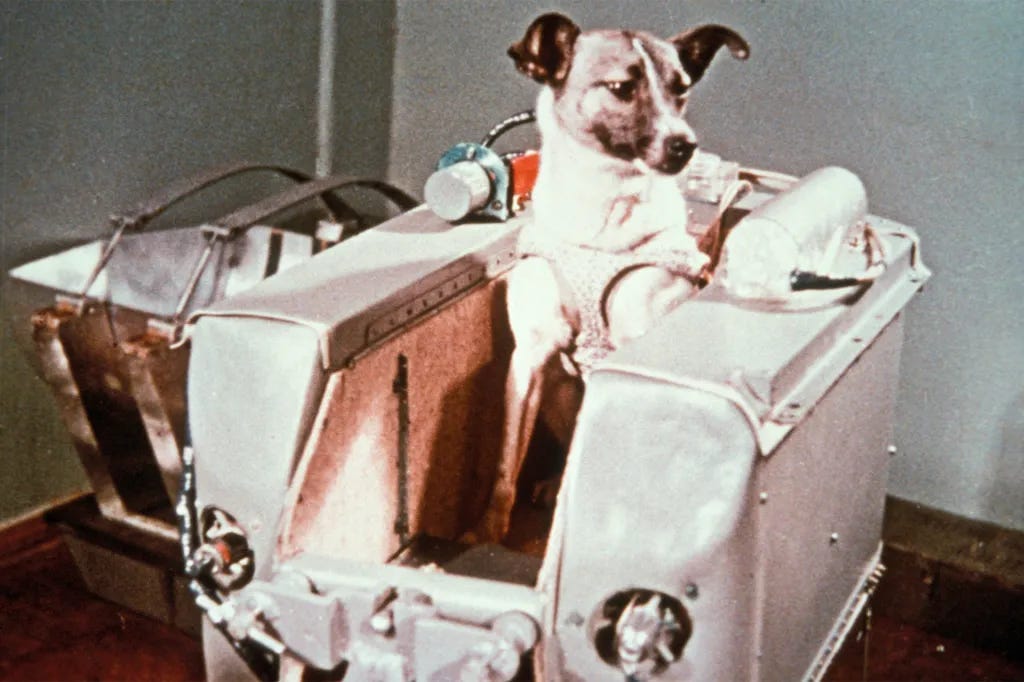
The other day I asked Kirby if there was any chance I could bring my dog Theo with me. He told me about Laika, the brave little Russian dog who was the first to go to space — but didn’t make it back. “Probably best to leave Theo here on Earth,” he said.
Fair enough. Some journeys you take knowing the ones you love most are cheering you on from home. But you take advice from Coach with you where you go in the Universe.