
Make Mars habitable again...
...terraforming the Red Planet within a thousand years can help us beat climate change on Earth today.

hello, future. it’s me, kev.
America’s politicians are excellent at short-term fights and terrible at long-term vision. Right now, most of our national energy goes into managing the present while the real generational work sits on the sidelines.
I think we need something bigger and more honest than another five-year strategy or another headline rocket launch. We need a thousand-year deadline to Make Mars Habitable Again.
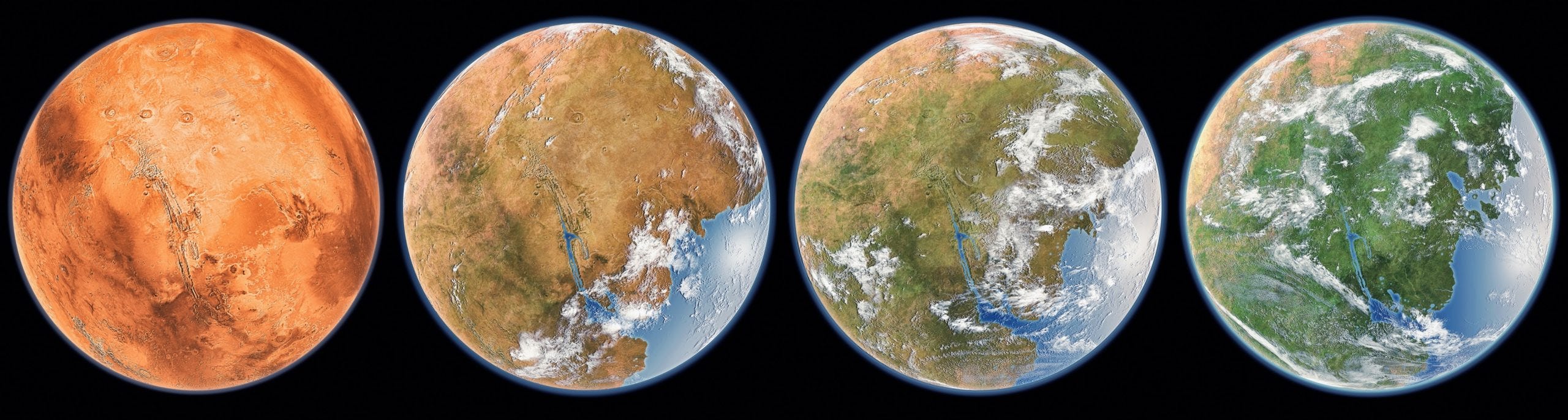
Why should Americans care about planning for one thousand years from now? Because the advances we make along the way, we can tackle climate change here on planet Earth today.
I explore the enviromentalist case for space exploration on a recent episode of my iHeart Media show HELLO FUTURE with Kevin Cirilli. Listen to that episode here.
Subscribe to HELLO FUTURE: iHeart | iTunes | Spotify | Amazon | Pandora
I’m not talking about a few people living in sealed boxes. I’m talking about the real thing: air you can breathe outside, liquid water that stays on the surface, soil that can grow things, and eventually the conditions for more complex life. That’s what “habitable” means here — not warm corners, but a world that actually works like Earth.
—> MARS WAS ONCE A LOT MORE LIKE EARTH: Scientists have strong evidence that billions of years ago, Mars was not the frozen desert we see today. It had a thicker atmosphere, warmer temperatures, and liquid water flowing on the surface. You can still see the old river valleys and lake beds from orbit, and rovers have found minerals that only form in the presence of water.
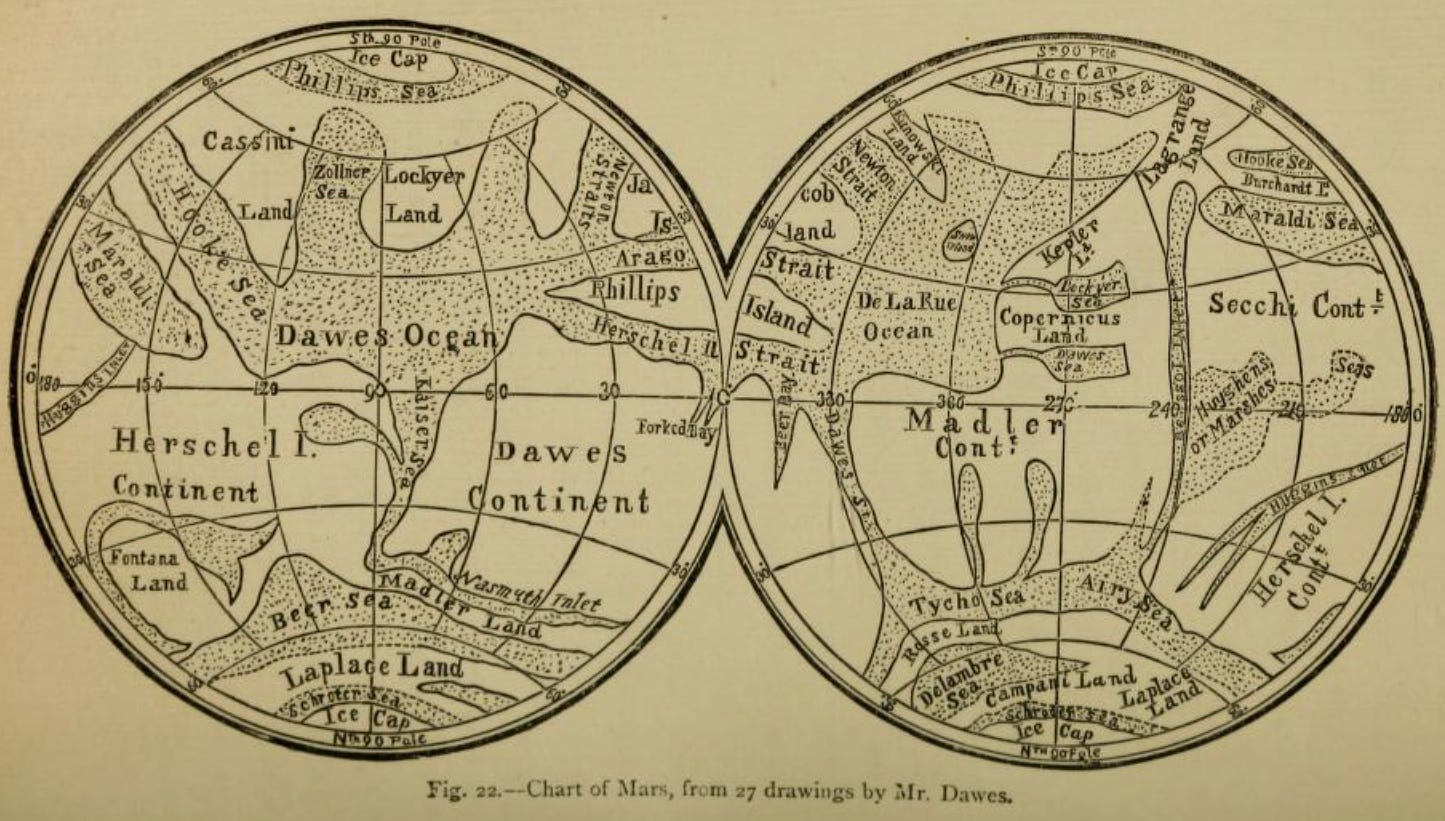
Something changed. The atmosphere thinned, the planet cooled, and the water either froze underground or was lost to space. So when we talk about making Mars habitable again, we’re not inventing something that never existed. We’re talking about restoring conditions that were already there a long time ago.
—> TERRAFORM TIME: Terraforming is the deliberate, large-scale engineering of a planet’s atmosphere and surface to make it suitable for Earth-like life. On Mars, that means warming the planet, thickening the atmosphere, and getting liquid water to stay on the surface instead of immediately freezing or boiling away.
This idea has been in serious scientific discussion since at least the 1960s and 1970s. Researchers like Carl Sagan were already exploring whether we could warm Mars on purpose. By the 1990s, scientists such as Christopher P. McKay were publishing detailed papers on how it might be done.
—> REAL RESEARCHERS ARE ALREADY WORKING ON THIS: This isn’t internet speculation. Legitimate scientists and institutions have been studying this seriously for decades:
Christopher P. McKay at NASA Ames has been one of the leading voices since the 1980s and co-authored the influential 1991 paper “Making Mars habitable” in the journal Nature.
Edwin Kite and his team at the University of Chicago published a major 2026 scientific roadmap that treats warming Mars as a real engineering problem with clear stages and constraints. You can read the paper here on arXiv.
In 2024, researchers held a dedicated Mars Terraforming Workshop (hosted by the Astera Institute and Pioneer Labs), which led to a perspective paper in Nature Astronomy making the case for sustained scientific work on making the planet habitable.
Martyn J. Fogg’s 1995 book Terraforming: Engineering Planetary Environments remains one of the foundational technical texts in the field.
These are serious people doing serious work at real institutions.
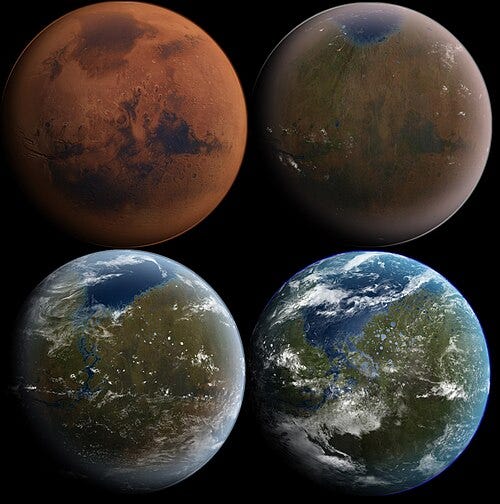
WHY A THOUSAND-YEAR PLAN ACTUALLY MAKES SENSE: Full terraforming — real breathable air, stable oceans, and functioning ecosystems — is not a project that finishes in one or two generations. The physics and the scale suggest it could take centuries, possibly approaching a thousand years to do properly.
We could have research outposts and even small colonies much sooner. But living your entire life inside pressurized habitats with no real sky and no ability to step outside unprotected is not a future most people would choose. A thousand-year plan is honest about the difference between having a presence on Mars and actually making it a livable world.

THE WORK WE DO ALONG THE WAY HELPS US ON EARTH RIGHT NOW: This is where the long timeline becomes practical. Every major technical challenge we solve to make Mars habitable creates tools we can use on Earth immediately — better materials for extreme environments, highly efficient systems for recycling air and water, new approaches to building with local resources, and much deeper understanding of how planetary climates actually work. Those capabilities don’t wait until Mars is finished. They start paying off as soon as we get serious about solving the problems.
—> AMERICA IS THE ONLY COUNTRY THAT CAN LEAD THIS: This isn’t just a science project. It’s a civilizational one. America has always done its best work when it has a place to test whether our innovation and our freedom could scale. Mars is the clearest frontier left. Right now, no other country combines the capital, the engineering culture, the willingness to take big risks, and the belief in expanding human freedom the way the United States still can.
We can keep managing the same narrow fights on Earth. Or we can give ourselves — and the generations after us — something worthy of a great nation: the chance to extend human life and human possibility to another world while learning how to better protect the one we already have.
The third rock from the sun doesn’t take care of itself. We do that by thinking bigger and longer than we’re used to.
With gratitude,
Kev
Sources: Phys.org – Could we actually terraform Mars? A new scientific roadmap lays out the blueprint; Starlust – Can we really terraform Mars? New study outlines a plan and the challenges; Universe Magazine – Can we really terraform Mars?